

GLV® Technology
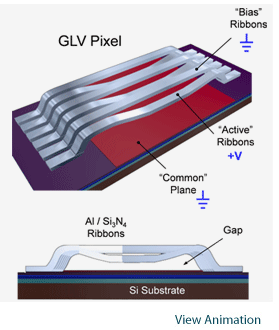
The Grating Light Valve (GLV®) is a high-performance spatial light modulator composed of thousands of free-standing silicon-nitride micro-ribbons anchored on the surface of a silicon chip. By electronically controlling the deflection of the ribbons, the GLV® functions as a programmable diffraction grating, enabling attenuation, modulation and switching of laser light with unparalleled resolution, speed and precision.
The GLV® is a class of Micro-Electro-Mechanical Systems (MEMS) and is built from amorphous, stoichiometric silicon nitride (Si3N4) – a robust high-temperature ceramic well-known for its hardness, durability and chemical stability. Individual ribbons are between 2-4 um wide and 100-300um long. The ribbons are coated with a thin aluminum layer which serves both as a reflector and electrode. The ribbons are suspended over a lower “common” electrode. When a controlled voltage from a CMOS channel driver is delivered to the ribbon, it deflects toward the substrate in response to the electrostatic force. After removing the voltage, the ribbon returns to its un-deflected state by nature of the high intrinsic tensile stress of the silicon nitride.